
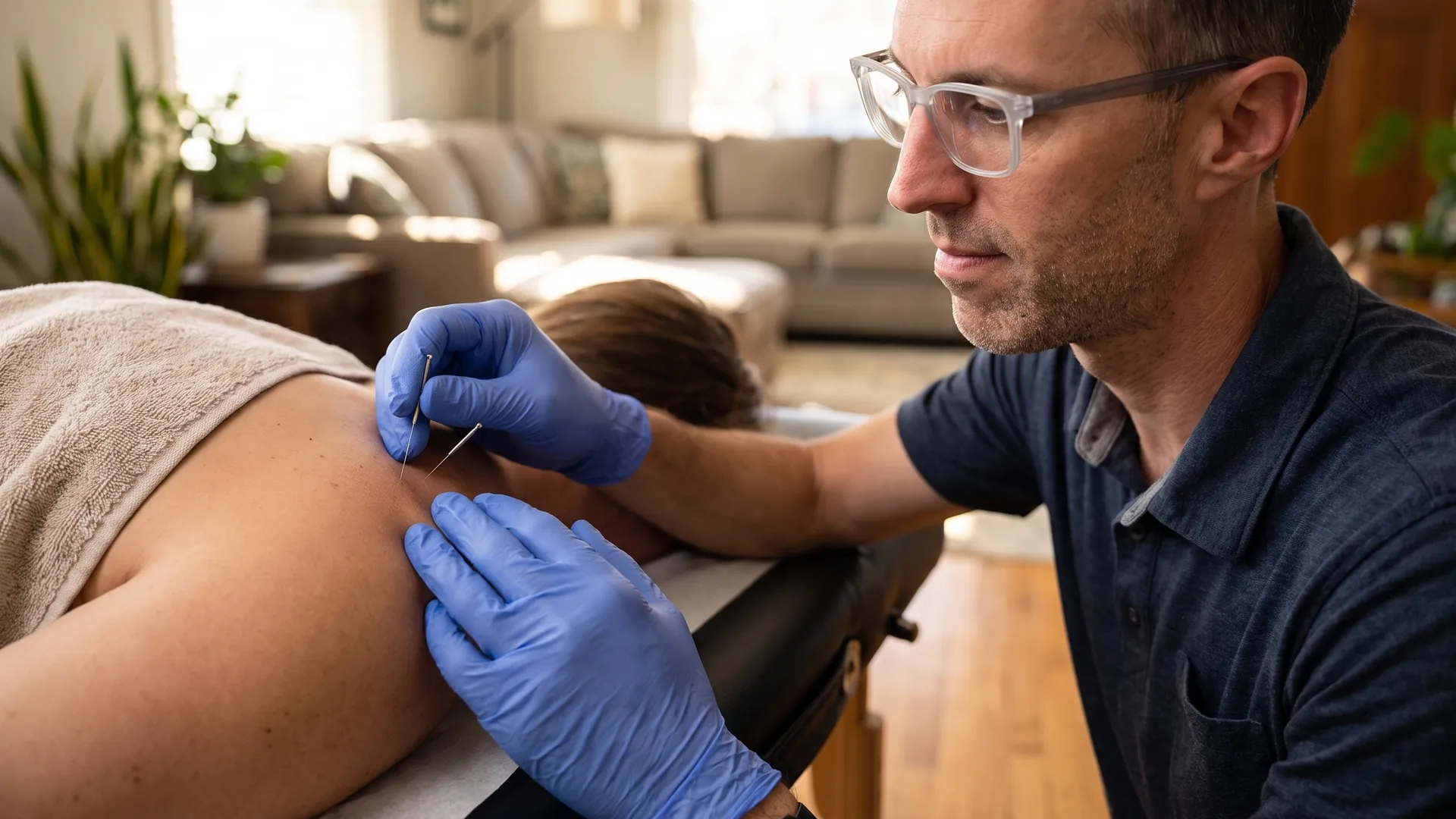

What Dry Needling Is
Dry needling uses a very fine, sterile, single-use needle placed into a muscle at the source of pain, tightness, or dysfunction. The goal is to release an active trigger point, or irritable spot in the muscle, so the muscle can relax, function as it is designed to, and stop referring pain to other places.
The needle carries no medication, which is why it is called dry. There is nothing injected. The needle itself does the work by creating a small, targeted response in the tissue that helps it reset. I often pair this with the application of electrical stimulation to the needle while it is in the muscle to help further reduce pain and re-educate that muscle to function with improved efficiency.
Dry needling is a large part of my practice. I am certified as a Functional Dry Needling Specialist, with more than 120 hours of coursework behind that certification, and I have used it for years alongside hands-on treatment and exercise.
What It Is Not
Dry needling is not acupuncture. The tools look similar, but the training, the reasoning, the application, and the goals are different. Acupuncture is based on traditional Chinese medicine. Dry needling is based on modern anatomy, physiology, and neuroscience, and it targets specific muscles, trigger points, and dysfunctions that I find during your examination.
It is also not a stand-alone fix. On its own, dry needling can give real relief. Paired with the right corrective exercise, it gives relief that lasts, because we are also fixing the reason the muscle got irritated in the first place.
What It Helps With
People come to me for dry needling most often for:
- Neck and upper back tightness, including headaches that start in the neck
- Shoulder pain and restricted reach
- Low back pain and hip tightness
- Gluteal and piriformis pain that runs down the leg
- Calf, hamstring, and quad strains
- Plantar fasciitis and Achilles tendon pain
- Tennis elbow and other tendon pain
- Muscle knots that have not responded to stretching, massage, or rest
If the muscle is part of the problem, dry needling is usually worth considering. If I do not think it will help you, I will tell you.
What It Feels Like
Most people feel very little from the needle going in. What you may feel is a brief twitch or a deep ache when the needle reaches the trigger point. That twitch is a good sign. It usually passes in a few seconds, and it is often followed by a noticeable sense of the muscle letting go.
Afterward, the area can feel a little sore, similar to how a muscle feels after a good workout. That typically fades within a day. I will give you simple guidance on movement and hydration to help with it.
How It Fits Into a Visit
I do not treat dry needling as a separate service with a separate price. It is one of the tools I use inside a regular sixty-minute visit, when your examination shows it is the right tool.
A typical visit that includes dry needling looks like this. We check in on how you have been since the last visit. I examine the area and confirm what the tissue is doing. I needle the specific muscles that need it. This typically provides a window of relief and we then use this window to work on movement and strength, so the improvement sticks.
Because I come to you, this all happens in your home or wherever we meet. You do not have to drive anywhere feeling stiff, and you can rest afterward in your own space.
Safety and Screening
Every needle is sterile and single use. Before your first needling session we go through your health history together, and I will ask about anything that changes how I approach it, such as a bleeding disorder, blood thinning medication, pregnancy, or a recent surgery. Dry needling is not right for everyone, and part of my job is knowing when it is contraindicated.
Dry needling in Kansas is performed by physical therapists who have completed specific training. I have gone beyond the basic training and completed the required coursework and exam to become certified as a Functional Dry Needling Specialist through Evidence in Motion.
Pricing
- Initial evaluation: $210, sixty minutes
- Follow-up visits: $160, sixty minutes
Dry needling is included in the visit when it is the right treatment. There is no add-on fee. Payment is at the time of the visit by cash, check, or Venmo, and HSA and FSA cards are welcome. I can provide a superbill if you want to submit to your insurance for possible out-of-network reimbursement.
No Referral Needed
You do not need a physician referral to see a physical therapist in Kansas. If your evaluation points to something beyond what I treat, I will say so and help you get to the right person.
How to Start
If you already know dry needling is what you want, request an evaluation and choose dry needling as your interest. I will get back to you within one business day. If you have questions first, book a free fifteen minute meet and greet by phone or video and ask me anything.